

Unlocking the Power of Emotions: How Your Values Shape Your Feelings and Decisions


When choices are abundant and emotions run high, understanding the intricate relationship between your values and feelings can transform how you navigate life. Every decision you make, from the mundane to the monumental, is influenced not just by what you want, but by the deeply held beliefs that underpin your very essence. By unlocking the power of emotions, you can gain clarity on how these values shape your perceptions, reactions, and ultimately, your path forward.
Dive into this exploration of self-discovery, where you will learn to recognize how aligning your decisions with your core beliefs can lead to profound insights, enriching your relationships, and enhancing your personal growth.
1. The Role of Emotions in Human Behaviour
Emotions are intrinsic to the human experience. They are the internal compass that guides our actions and contribute to the rich tapestry of human proficiency. Often, we find ourselves swept up in a whirlwind of feelings, from the highs of joy to the depths of despair, without fully understanding the nature or origin of these emotions.
When we talk about essential emotions, we are referring to the core feelings that are universal across cultures. They are fundamental to our survival, influencing our decisions, perceptions and behaviours in profound ways.
To comprehend our emotional backdrop, we must first recognize to delve into the intricacies of our psychological and biological makeup. It involves exploring how these emotions arise, the purpose they serve, and how they interact with one another. It also means acknowledging that our emotional responses are not always rational or controllable but are deeply rooted in our evolutionary history. By gaining insight into these essential emotions, we can begin to unravel the complexities of our inner world and develop a greater sense of self-awareness.
2. An overview of a few Essential Emotions

These emotions include:
Admiration
Amusement
Anger
Awe
Anticipation
Astonish
Compassion
Contentment
Desire
Disgust
Disappointment
Envy
Fear
Frustration
Gratitude
Grief
Guilt
Hope
Jealousy
Joy
Love
Pride
Relief
Resilience
Sadness
Shame
Shock
Surprise
Trust
Navigating the complexity of human emotions begins with recognizing the core feelings that shape our experience. Each of these essential emotions plays a distinct role, guiding us and supporting our emotional well-being.
3. Understanding the Connection Between Values and Emotions
Values and emotions are intertwined in a complex and profound relationship that shape our experiences and decisions (Deonna, J. A., & Teroni, F. (2015) ).Values are deeply ingrained principles that guide our behaviour and judgments, while emotions are the immediate responses we have to different situations. When we make decisions, it is often our values that dictate which emotions come to the forefront. For instance, if honesty is a core value, we might feel guilt or discomfort when lying. Conversely, acting in alignment with our values can lead to feelings of satisfaction and fulfillment.
The connection between values and emotions is not always straightforward. Sometimes, our values can be in conflict, leading to mixed emotions. For example, if we value both family and career advancement, we might experience tension when faced with a decision that benefits one at the expense of the other.
Your emotions as well play a vital role to influence your values. While emotions can motivate and steer you in meaningful directions, they can also cloud judgment and lead to biased choices. By paying attention to your emotional reactions, you can spot patterns and triggers, pause to reflect, and make sure your decisions align not just with momentary feelings but with your long-term values and goals.
Recognizing this link between values and emotions can empower us to live more authentic lives. By paying attention to our emotional responses and reflecting on the values that drive them, we can gain deeper insights into who we are and what truly matters to us. This self-awareness is the first step in unlocking the power of emotions and using them as a guide in our decision-making process.
4. Identifying Your Personal Values
Identifying your personal values is a crucial step in understanding how they shape your emotions and decisions. Personal values are the principles and standards that are most important to you, guiding your behaviour and judgments. To identify your values, start by reflecting on moments when you felt truly fulfilled and satisfied. What were you doing then? What principles were you honouring? These moments can provide valuable clues about your core values.
Another effective method for identifying your values, is by attempting he Core Value Finder Test. Based on scientific research, introduced by Shalom Schwartz, the test illustrates personalized results for different value profiles that a person can have. Core values serve as a compass that guides our decisions, big and small. They are the fundamental beliefs that define what we stand for and shape our priorities. Incorporating core values into decision-making requires self-reflection and honesty. It involves examining our choices and considering whether they align with what we hold dear. Understanding the continuum through the test can further provide insight into what matters most to you.
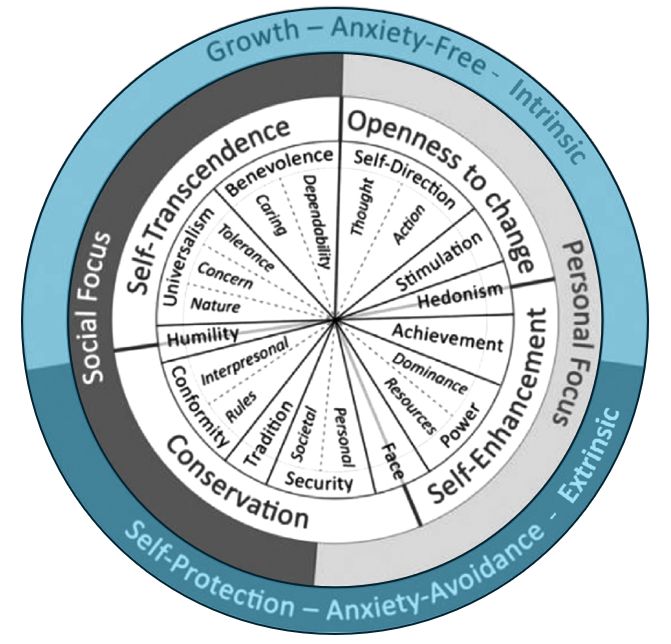

Once you have identified your personal values, it is essential to prioritize them. Not all values carry the same weight, and some may take precedence over others in certain situations. By ranking your values in order of importance, you can create a clearer framework for decision-making. This prioritization helps you stay focused on what is truly significant to you, especially when faced with challenging choices.
5. The Impact of Core Values on Emotional Well-Being
Living in alignment with your values profoundly shapes your emotional well-being. When your actions reflect what you truly believe, you feel authentic and congruent, which brings deep emotional satisfaction and inner peace.
But when there’s a gap between your values and your actions, you’re likely to experience emotional distress, often in the form of anxiety, guilt, or frustration. For instance, if you value self- direction yet find yourself compromising and conforming to your integrity, the resulting turmoil can weigh heavily on your mental health. Recognizing and addressing these mismatches is essential for maintaining emotional balance.
Your values influence how you face and overcome life’s challenges. When faced with difficult situations, our values provide a source of strength and resilience. They remind us of what is truly important and help us navigate adversity with a sense of purpose and determination. By staying connected to our values, we can find meaning in our experiences and emerge stronger from the trials we encounter.
6. Strategies for Aligning Values with Emotions (Reaction/Actions)
- Enhancing emotional intelligence is key to effectively managing the interplay between values and emotions. One practical exercise is mindfulness and self -awareness, which involves paying attention to the present moment without judgment. This practice can help you become more aware of your emotional responses and the underlying values that drive them. By cultivating mindfulness, you can develop greater clarity and control over your emotions and decisions.
- Understanding the neuroscience behind emotions and values can help us appreciate the biological basis of our decision-making processes. It highlights the importance of emotional regulation and cognitive control in aligning our actions with our values. The somatic marker hypothesis, proposed by neuroscientist Antonio Damasio, suggests that emotions serve as markers that help us evaluate the potential outcomes of our decisions. These emotional signals, or "gut feelings," guide us towards choices that align with our well-being and away from those that may lead to negative consequences. This is why it is important to develop emotional intelligence, which involves recognizing and managing our emotions to make more balanced and informed choices.
- The exercise of journaling or with answering questionnaires like, the Core Value Finder mentioned earlier can really be helpful. One can learn more about their values, emotions and t experiences. This practice allows you to explore the connections between your values and feelings, identify patterns, and gain insights into your decision-making process. They serve as a tool for self-expression and emotional release, helping you process complex emotions and stay aligned with your values.
- Engaging in your values boosts your emotional intelligence. By identifying and prioritizing your core values, reflecting on their impact, and setting aligned goals, you create a clear guide for meaningful action. Research shows that stronger self-transcendence values foster emotions tied to connection, while self-enhancement values link to both affiliation and achievement emotions.(Conte, B., Brosch, T., & Hahnel, U. J. (2023) ). For example, if health is a core value, committing to regular exercise or balanced eating keeps you true to it. Aligning daily choices with your values deepens self-awareness, enriches relationships, and strengthens purpose, helping you navigate life with authenticity, resilience, and a genuine sense of fulfillment.
7. Conclusion: Embracing Your Values for Better Decision-Making
Values are the silent narrators of our stories, and the unseen forces that shape our destinies.
Understanding this dynamic can help us navigate our emotional responses more effectively and make choices that are true to our core beliefs.
Ultimately, unlocking the power of emotions through the lens of your values can transform your life. It enables you to make informed and meaningful decisions, navigate challenges with resilience, and live a life that is true to your essence. By staying true to your core beliefs, you can enhance your emotional well-being, strengthen your relationships, and achieve personal growth.
Embrace your values - harness the power of your emotions, and let their light illuminate your journey towards a more authentic and fulfilling life.
You can also read on -
- Deonna, J. A., & Teroni, F. (2015). Value and emotion. In Oxford University Press eBooks (pp. 155–174). https://doi.org/10.1093/acprof:oso/9780198716600.003.0008
- Schwartz, S. H. (2012). An Overview of the Schwartz Theory of Basic Values. Online Readings in Psychology and Culture, 2(1). https://doi.org/10.9707/2307-0919.1116
- Damasio, A. R. (1994). Descartes’ error: emotion, reason, and the human brain. http://ci.nii.ac.jp/ncid/BA81390277
- Conte, B., Brosch, T., & Hahnel, U. J. (2023). Initial evidence for a systematic link between core values and emotional experiences in environmental situations. Journal of Environmental Psychology, 88, 102026. https://doi.org/10.1016/j.jenvp.2023.102026
About The Author
As the Director of Content Marketing at Vivid Ground GbR, Naazish Kazi is passionate about advancing digital health through the he Core Values Finder, a tool designed to help individuals and organizations align with their core values for improved mental and physical well-being. With a focus on meaningful impact, she supports coaches and companies in creating value-driven change, always guided by the belief that personal insight can drive societal progress.
 07.02.25
Why Aligning Your Personal Values with Company Values Can Transform Your Career?
When your personal values resonate with your company’s work becomes more than just a job, it becomes a meaningful pursuit. This alignment fuels passion,…- 07.23.25
Unlocking the Power of Emotions: How Your Values Shape Your Feelings and Decisions
Your emotions aren’t random, they’re powerful signals of what truly matters to you. Learn how your core values influence what you feel, why you…  01.31.23
How to Increase Your Self-Value and Feel Confident in Yourself in 2025?
Developing self-confidence and self-worth is the aim of self-value. You can achieve your self-value goals in 2023 through personal growth, career development, relationships, or… 02.15.23
The Power of Emotional Intelligence: Develop Your EQ and Unlock Your Potential In 2023
Discover how to understand, manage, and use emotions effectively with our practical tips and strategies, and unlock your full potential by 2023. Our guide… 08.23.22
Core Values: A Perfect North Star To Your Life Goals.
Core Values are the guiding principles to achieve your life goals. And here is all you need to know about CORE VALUES!… 09.28.22
Personality Values: A Quick Reference Guide
Understand how different personality types influence our lives, and how to deal with them appropriately.…